

What to Do If Your NEET Score Is Low? Top Career Options and Alternative Pathways
Getting a lower-than-expected NEET score can be hard to accept. You may have spent months preparing, sacrificed time with friends and family, and imagined yourself studying MBBS. When the result doesn’t match those expectations, it is natural to feel disappointed or unsure about what comes next.
But a low NEET score does not mean your future in healthcare is over. It means you need to understand your options before making your next move.
Some students may benefit from preparing for another attempt. Others may find suitable opportunities in private medical colleges, AYUSH programmes, allied health sciences, or related healthcare degrees. The right choice depends on your score, eligibility, financial circumstances, and genuine career interests.
If you are wondering what to do after a low score in NEET, this guide will help you evaluate your options practically, without making a rushed decision.
1. First, Understand What Your NEET Score Means
Before choosing another course, check your NEET score, All India Rank, qualifying status, and the relevant year’s counselling information.
Remember that qualifying NEET and securing an MBBS seat are two different things. A candidate may meet the qualifying requirement but still fall short of the rank needed for a particular college or category.
Review the official NEET-UG website for the information bulletin, results, and public notices. Then check the relevant counselling authority’s seat matrix, eligibility rules, and previous allotment information.
Do not judge your chances using a single cutoff screenshot circulating on social media. Admission possibilities vary by category, state, college, quota, and counselling round.
2. Should You Repeat NEET?
If MBBS remains your clear goal, taking another attempt may be worth considering. However, repeating the exam should be a planned decision—not simply a reaction to disappointment.
A repeat attempt may suit you if you understand where you lost marks, can improve your preparation, and are ready to follow a structured study plan.
Before deciding, ask yourself:
- Were your mistakes mainly related to concepts, time management, or exam pressure?
- Can you realistically improve your performance with a different study strategy?
- Can your family support another preparation cycle?
- Are you willing to practise mock tests and review mistakes consistently?
If you choose to repeat, set measurable monthly targets and track progress. Also keep alternative courses in mind so that your entire future does not depend on one exam result.
A second attempt can be a sensible investment when it is supported by a realistic plan. It is not compulsory for every student.
3. Explore Private Medical College MBBS Seats
Students often investigate private medical colleges when their scores are not competitive for government seats. Depending on their NEET qualification, rank, budget, and the applicable admission rules, some private-college seats may be worth exploring.
However, management quota does not mean admission without NEET or guaranteed admission regardless of rank. Candidates must satisfy the applicable eligibility requirements and follow the authorised counselling process.
Before proceeding, compare:
- The official fee structure for the relevant seat category.
- Tuition, hostel and other expenses across the full course.
- The college’s recognition and hospital facilities.
- Seat availability and counselling requirements.
- Payment deadlines, refund rules and security deposits.
For central counselling categories, consult the Medical Counselling Committee (MCC). Karnataka applicants should also check the current notifications from the Karnataka Examinations Authority (KEA).
Do not pay an agent who promises a guaranteed seat without official documentation. Verify every offer with the relevant authority or institution.
4. Consider AYUSH Courses Such as BAMS and BHMS
If you are interested in a healthcare career but are open to a different medical system, consider programmes such as:
- BAMS: Bachelor of Ayurvedic Medicine and Surgery.
- BHMS: Bachelor of Homoeopathic Medicine and Surgery.
- BUMS: Bachelor of Unani Medicine and Surgery, subject to eligibility and availability.
- BSMS: Bachelor of Siddha Medicine and Surgery, where offered.
These courses have distinct curricula and professional frameworks. They should not be treated as shortened versions of MBBS.
Importantly, NEET-UG applies to these undergraduate AYUSH courses as specified by the relevant regulations. Admission depends on the required qualifying status, eligibility, and counselling process.
For official counselling information, visit the Ayush Admissions Central Counselling Committee (AACCC). Consider these programmes only if you have a genuine interest in the system of medicine you would study.
5. Allied Health Sciences: Healthcare Careers Beyond MBBS
For students searching for medical courses without NEET, allied health sciences may offer promising alternatives. Admission requirements differ by programme and college, and many courses use their own eligibility criteria or selection process.
Options to explore include:
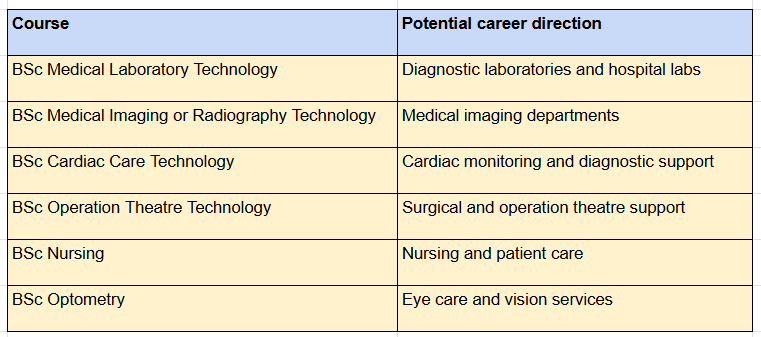
Other options may include pharmacy, biotechnology, microbiology, and life sciences, depending on your interests and eligibility.
The National Commission for Allied and Healthcare Professions (NCAHP) provides information on standards and professional regulation in allied healthcare.
When comparing colleges, look beyond the course name. Check practical training, hospital exposure, internships, recognition, and placement information. These details can make a meaningful difference to your learning and employment prospects.
6. Is Studying MBBS Abroad a Good Option?
Some students consider studying medicine overseas when admission in India seems difficult. This can be an option for eligible students, but it requires careful research and financial planning.
Before paying an overseas university, verify the institution, course structure, language of instruction, clinical training, internship arrangements, and total expenses. Also investigate accommodation, travel, currency fluctuations, and the country’s licensing requirements.
For Indian students planning to practise in India after graduating abroad, foreign medical qualification and licensing requirements are especially important. The applicable rules may include requirements concerning NEET eligibility, course duration, clinical training, and the licensing or screening process in India.
Read the current National Medical Commission (NMC) regulations and notices before committing. Do not rely solely on claims made by an overseas admission agency.
Studying abroad should be a well-researched educational decision, not an impulsive response to a disappointing score.
7. How to Choose the Right Path for You
When comparing low NEET score options, use three practical considerations: interest, affordability, and eligibility.
First, decide whether becoming an MBBS doctor remains your main goal. If it does, assess another attempt or realistic admission opportunities. If you are open to other healthcare professions, investigate the day-to-day work involved in each alternative.
Next, calculate the full cost of the course, including tuition, accommodation, and other expenses. Finally, confirm eligibility and recognition through official sources.
Avoid choosing a programme simply because somebody describes it as high-paying or easy to enter. Talk to qualified professionals, compare course curricula, and understand the responsibilities associated with the qualification.
How AECS EDU WORLD Can Help
Choosing a course after NEET can feel overwhelming when you are balancing expectations, expenses, and uncertainty. A clear comparison of your available pathways can help you make a more confident decision.
AECS EDU WORLD can help you explore education options and identify the questions to ask while evaluating colleges and admission routes. Visit the AECS EDU WORLD website or contact the team to discuss your next steps.
Conclusion
A low NEET score can change your immediate plans, but it does not have to define your future. You can assess another attempt, investigate eligible private MBBS seats, consider AYUSH programmes, explore allied health sciences, or research overseas medical education.
Take time to verify the rules, understand the costs, and choose a course that fits your interests. Your next step should be based on reliable information and a realistic plan—not pressure from others or fear of falling behind.